The Best Commercial Oven For Baking Guide You Need
Choosing the right commercial oven for baking can transform your bakery operations and product quality. This guide covers every type of commercial oven, from deck ovens to rack ovens, so you can make a confident buying decision. You will learn about key features, top models, pricing factors, and maintenance tips that actually matter. We break down complex choices into simple, actionable advice that works for both new bakery owners and seasoned professionals.
Running a bakery is no small feat. Every loaf of bread, every pastry, and every cake depends on one thing working perfectly. That thing is your commercial oven for baking. The right oven can make your products rise higher, bake more evenly, and come out looking bakery-worthy every single time. The wrong one? That is a recipe for frustration, wasted ingredients, and unhappy customers.
If you are shopping for a new commercial oven for baking, you probably already know how overwhelming the options can be. There are deck ovens, rack ovens, convection ovens, and more. Each one promises to be the best. But which one actually fits your bakery? This guide answers that question in plain, simple terms. We will walk you through every type, every feature, and every consideration you need to make. By the end, you will feel confident picking the perfect commercial oven for baking for your shop.
Let us be real for a moment. Your oven is the heart of your bakery. It works hard every day, often for 10 to 16 hours straight. So investing time in choosing the right one pays off big time. Whether you run a small artisan bakery or a large production facility, this guide has you covered. Let us dive in.
Key Takeaways
- Right oven type matters: Deck, rack, convection, and pizza ovens each serve different baking needs and production volumes.
- Capacity and size are critical: Match your oven to your bakery output goals to avoid waste or bottlenecks.
- Energy efficiency saves money: Gas and electric commercial ovens have different operating costs that impact your bottom line.
- Key features like steam injection and temperature control improve bake quality: These details set professional ovens apart.
- Top brands offer reliability and support: Investing in trusted names reduces downtime and repair costs.
- Regular maintenance extends oven life: Simple cleaning and servicing routines keep your commercial oven for baking running smoothly for years.
📑 Table of Contents
- Understanding Commercial Ovens For Baking
- Types Of Commercial Ovens For Baking
- Key Features To Look For In A Commercial Oven For Baking
- Comparing Top Commercial Ovens For Baking
- How To Choose The Right Commercial Oven For Baking
- Maintaining Your Commercial Oven For Baking
- Final Thoughts On Choosing Your Commercial Oven For Baking
Understanding Commercial Ovens For Baking
A commercial oven for baking is very different from the oven sitting in your kitchen at home. These machines are built to handle high volume, consistent heat, and heavy daily use. They come in various sizes, fuel types, and designs. Each design serves a specific purpose in the world of bakery equipment.
The first thing to understand is that not all bakes are the same. A artisan sourdough needs steady, dry heat at lower temperatures for a long time. A batch of cookies needs quick, even heat at higher temperatures. A large bread order might require loading dozens of loaves at once. Your oven choice must match these needs. This is why knowing the basics matters before you start shopping.
Why Oven Type Impacts Your Bake Quality
The type of commercial oven for baking you choose directly affects how your products turn out. Heat distribution, moisture control, and temperature recovery time all vary by oven design. For example, a deck oven provides gentle, radiant heat from below. This is ideal for artisan breads that need a crispy crust and an open crumb. A convection oven circulates hot air around the food. This works great for pastries and cookies that need even browning on all sides.
Choosing the wrong oven type can lead to uneven baking, longer cook times, and higher energy bills. It can also limit what you can produce. So take the time to understand your baking needs before you commit to a purchase. Your future self and your customers will thank you.
Types Of Commercial Ovens For Baking
The market offers several types of commercial ovens for baking. Each one has strengths and ideal use cases. Let us break them down so you can see which fits your bakery best.
Deck Ovens
A deck oven is one of the most popular choices for artisan bakeries. It features one or more stone or steel decks that hold your baked goods directly. The heat comes from below and sometimes from the top as well. This creates that beautiful crust you see on artisan breads and rustic loaves.
Deck ovens excel at convection baking for breads, focaccia, and pastries. They offer excellent heat retention and a natural steam environment. Many bakers love the control they provide over individual bake cycles. Commercial deck ovens for baking come in single-deck and double-deck configurations. A single deck holds fewer items but gives you more flexibility. A double deck doubles your capacity without doubling your floor space.
Rack Ovens
Rack ovens for commercial baking are the workhorses of large-scale production. They feature a large chamber where you load entire racks of sheet pans. This makes them perfect for bakeries that produce high volumes of cookies, muffins, and sheet cakes. You can load and unload quickly, which saves valuable time during busy production runs.
These ovens are highly efficient for continuous baking. They also offer excellent temperature uniformity across all racks. If your bakery fills hundreds of trays per day, a rack oven commercial setup is hard to beat. They do take up more space and require more utility connections, though.
Convection Ovens
Commercial convection ovens for baking use fans to circulate hot air throughout the cavity. This creates a very even baking environment. Every item on every tray receives the same amount of heat. This makes convection ovens incredibly versatile for bakeries that produce a wide variety of products.
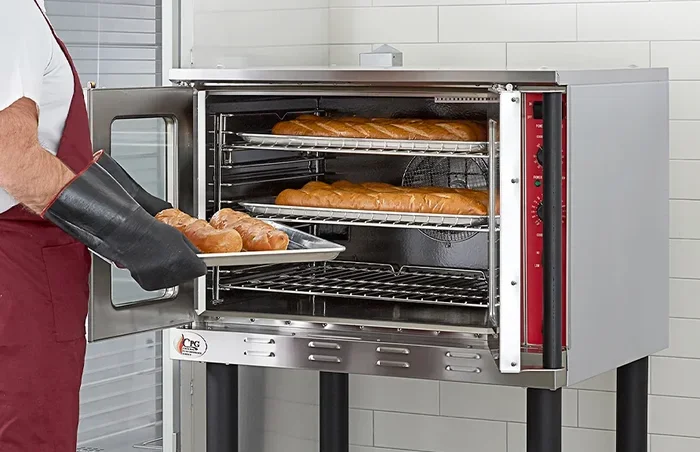
They work well for cakes, cookies, puff pastries, and even roasted items. Many convection bakery ovens also include steam injection features. This lets you create the perfect crust for artisan breads without needing a separate oven. If you want one oven that handles almost everything, a commercial convection oven for baking is a strong contender.
Pizza Ovens
For bakeries that also make pizza or focaccia, a dedicated commercial pizza oven for baking can be a game changer. These ovens reach very high temperatures, often above 800 degrees Fahrenheit. They cook pizzas in just 60 to 90 seconds. The result is a perfectly charred, blistered crust that is hard to replicate in a standard oven.
Wood-fired and gas-fired pizza ovens are the most common types. They add a unique flavor profile that customers love. However, they are specialized. If your bakery does not make pizza regularly, a standard deck or convection oven might serve you better.
Steam Ovens
Commercial steam ovens for baking combine dry heat with injected steam. This gives bakers incredible control over the baking environment. Steam at the start of a bake keeps the crust soft, allowing maximum oven spring in breads. Then dry heat finishes the bake for a crisp crust.
These ovens are increasingly popular in artisan and craft bakeries. They produce stunning results with sourdough, baguettes, and brioche. However, they come at a higher price point. They also require a water supply and drainage, which adds installation complexity.
Key Features To Look For In A Commercial Oven For Baking
Not all commercial ovens for baking are created equal. When comparing models, focus on the features that actually matter for your daily operations.
Temperature Range and Control
Your oven needs to reach and hold the right temperatures for your products. Most commercial bakery ovens offer a range from 150 to 550 degrees Fahrenheit. Some high-end models go even higher. What matters more than the range is how precisely the oven holds its temperature.
Look for ovens with digital controls and programmable bake profiles. These let you save specific temperature and time settings for different products. This reduces guesswork and ensures consistency batch after batch. Temperature uniformity across the oven cavity is equally important. You do not want the front row of loaves baked perfectly while the back row is underdone.
Capacity and Load Size
Capacity is one of the most important factors when choosing a commercial oven for baking. Think about your peak production volume. How many sheet pans do you bake per hour? How many loaves of bread do you need per day?
A good rule of thumb is to size your oven for about 120 to 150 percent of your current volume. This gives you room to grow without needing a second oven right away. Also consider the physical footprint. Make sure the oven fits your kitchen layout with enough clearance for loading, unloading, and maintenance access.
Energy Efficiency and Fuel Type
Commercial oven energy efficiency directly impacts your operating costs over the life of the machine. The two main fuel types are gas and electric. Gas ovens typically have lower operating costs in areas where natural gas is affordable. They also heat up faster and recover temperature quickly after the door opens.
Electric ovens are easier to install since they do not require a gas line or ventilation system. They also offer more precise temperature control in many models. Electric commercial ovens for baking tend to be more expensive to run in the long term, though. Consider your local utility rates and your bakery’s energy consumption when making this decision.
Steam Injection and Humidity Control
Steam plays a vital role in many baking processes. It keeps the crust soft during the early stages of baking, allowing the bread to expand fully. It also creates that glossy, professional-looking finish on artisan loaves.
Ovens with built-in steam injection systems give you this capability without extra equipment. Some models offer multi-stage steam control, letting you add steam at precise intervals. This level of control is especially valuable for bakers who specialize in sourdough, baguettes, and other artisan breads. If you plan to expand your bread lineup, prioritize steam injection ovens for baking.
Durability and Build Quality
A commercial oven for baking is a long-term investment. Look for units built with heavy-gauge stainless steel and robust insulation. The doors should seal tightly to prevent heat loss. Hinges, handles, and gaskets should feel solid and well-constructed.
Check the warranty and the availability of replacement parts. A manufacturer that offers strong customer support makes your life much easier when something goes wrong. Also read reviews from other bakery owners. Real-world experience tells you more than any product brochure ever could.
Comparing Top Commercial Ovens For Baking
Let us look at how the main types of commercial ovens for baking stack up against each other. This comparison helps you see which oven type fits your needs best.
| Feature | Deck Oven | Rack Oven | Convection Oven | Steam Oven |
|---|---|---|---|---|
| Best For | Artisan breads, pastries | High-volume cookies, muffins | Variety baking, pastries | Artisan breads, crust control |
| Capacity | Medium | High | Medium to High | Medium |
| Heat Source | Radiant (top and bottom) | Radiant or convection | Forced air circulation | Steam + dry heat |
| Energy Use | Medium | High | Medium | Medium to High |
| Price Range | Mid to High | High | Low to High | High |
| Floor Space | Compact | Large | Medium | Medium |
| Ease of Use | Very Good | Good | Very Good | Good |
This table gives you a quick snapshot, but your specific needs may shift the balance. A small artisan bakery might find that a deck oven covers 90 percent of its needs perfectly. A large commercial bakery producing packaged goods will likely need a rack oven for efficiency. The key is matching the oven to your actual workflow.
How To Choose The Right Commercial Oven For Baking
Now that you understand the types and features, let us talk about the decision-making process. Choosing the right commercial oven for baking comes down to a few key steps.
First, define your bakery goals. Are you an artisan bakery focused on crusty breads and delicate pastries? Or are you a high-volume operation producing hundreds of identical items daily? Your answer determines the oven type. An artisan bakery thrives with a deck oven or steam oven. A production facility needs a rack oven or large convection oven.
Second, measure your available space. Bring a tape measure to your kitchen. Note the height, width, and depth of the area where the oven will go. Leave room for ventilation and access. A cramped installation leads to overheating and safety hazards.
Third, set a realistic budget. Commercial oven price ranges vary widely. A basic commercial convection oven for baking might start around 3,000 dollars. A high-end steam injection deck oven can cost 15,000 dollars or more. Remember to factor in installation costs, utility hookups, and any kitchen modifications needed.
Fourth, consider your fuel options. If your bakery already has a gas line, a gas oven makes sense. If not, electric might be the simpler path. Talk to a kitchen designer or contractor if you are unsure. They can help you understand what your space can support.
Fifth, read reviews and talk to other bakers. Online forums, industry groups, and trade shows are goldmines of real-world feedback. Ask about reliability, customer service, and how the oven performs under daily use. This kind of insight is invaluable and often overlooked.
Quick Tips For Making Your Final Decision
- Always request a demo or trial period if possible.
- Ask the manufacturer about lead times for delivery and installation.
- Consider total cost of ownership, not just the purchase price.
- Check if the oven meets local health and safety codes.
- Think about your menu for the next three to five years, not just today.
Maintaining Your Commercial Oven For Baking
Buying the oven is only half the battle. Proper maintenance keeps your commercial oven for baking running efficiently for years. A well-maintained oven bakes better, uses less energy, and lasts longer. Neglecting maintenance leads to uneven heating, higher bills, and costly repairs.
Start with daily cleaning. Wipe down the interior after each use to remove flour, crumbs, and grease buildup. Check the door seals regularly. A worn gasket lets heat escape, which forces the oven to work harder. Inspect the heating elements for any signs of damage or uneven glow.
Schedule professional maintenance at least once or twice a year. A technician can check calibration, inspect electrical or gas connections, and identify potential problems before they become expensive failures. Keep a maintenance log to track service dates and any recurring issues.
For steam ovens, follow the manufacturer’s guidelines for descaling and water treatment. Mineral buildup can damage steam generators and reduce efficiency. Using filtered water and flushing the system regularly goes a long way toward preventing problems.
Also train your staff on proper oven use. Opening the door too often wastes heat. Overloading racks blocks airflow. Simple habits make a big difference over time. When your team understands the equipment, they take better care of it.
Common Mistakes To Avoid
- Skipping regular calibration checks. Even a small temperature drift affects bake quality.
- Ignoring unusual noises or smells. These are early warning signs of problems.
- Using abrasive cleaners on interior surfaces. This damages coatings and affects food safety.
- Overloading the oven beyond its rated capacity. This strains the heating system and leads to uneven baking.
- Delaying repairs. Small issues become big, expensive problems when left unaddressed.
Final Thoughts On Choosing Your Commercial Oven For Baking
Finding the best commercial oven for baking does not have to be a stressful experience. When you understand your needs, know the options, and focus on the features that matter most, the decision becomes much clearer. Start with your bakery’s production goals, then work through the types, features, and budget considerations.
The right commercial oven for baking is an investment in your bakery’s future. It affects every product you make, every hour you operate, and every customer you serve. Take your time, do your research, and choose the oven that fits your bakery today and tomorrow. Your baked goods will taste better, your operations will run smoother, and your profits will reflect the smart choice you made.
Remember, no single oven is perfect for every bakery. The best commercial oven for baking is the one that aligns with your specific products, volume, and kitchen setup. Trust your research, lean on expert advice, and never underestimate the power of a great oven in a great bakery.
Frequently Asked Questions
What is the best commercial oven for a small bakery?
A deck oven or a compact convection oven works best for most small bakeries. They offer great versatility without taking up too much space. A single-deck commercial oven for baking can handle breads, pastries, and cookies with excellent results.
How much should I expect to pay for a commercial oven for baking?
Commercial oven price ranges from around 3,000 dollars for a basic convection model to over 20,000 dollars for a high-end steam injection deck oven. Your budget depends on oven type, capacity, and features. Always factor in installation and utility costs as well.
Should I choose a gas or electric commercial oven for baking?
Gas ovens heat up faster and often have lower operating costs. Electric ovens offer precise temperature control and easier installation. Your local utility rates and kitchen setup should guide this decision. Many bakeries find that gas commercial ovens for baking suit high-volume operations better.
How often should I service my commercial oven for baking?
Schedule professional maintenance at least once or twice a year. Daily cleaning and weekly deep cleans keep the oven performing well between service visits. Regular oven maintenance extends the life of the unit and prevents costly breakdowns.
Can a commercial oven for baking handle both bread and pastries?
Yes, many commercial convection ovens for baking handle both bread and pastries beautifully. Steam injection models offer even more flexibility for different bake profiles. The key is choosing an oven with the right temperature range and humidity control for your product mix.
What size commercial oven do I need for my bakery?
Measure your peak production volume and multiply by 1.2 to 1.5 for growth room. Consider the physical space available in your kitchen and the types of pans or trays you use. A rack oven suits high-volume operations while a deck oven works well for artisan bakeries with moderate output.
=== CONCLUSION ===
Choosing the right commercial oven for baking is one of the most important decisions you will make for your bakery. It shapes your product quality, your efficiency, and your long-term success. We have covered every major oven type, from deck ovens to convection ovens to steam ovens. We have explored the features that matter most, including temperature control, capacity, energy efficiency, and durability.
The best commercial oven for baking is the one that fits your bakery’s unique needs. There is no universal winner. Your artisan sourdough demands a different oven than a mass-produced cookie line. Use this guide to narrow your options, compare models, and make a confident choice. Invest in quality equipment, maintain it well, and your oven will reward you with consistent, beautiful bakes for years to come.
Now go find your perfect commercial oven for baking. Your bakery deserves the best, and so do your customers.