What Does PID Mean Coffee Machine A Simple Explanation
PID stands for Proportional Integral Derivative, and it is a smart temperature control system that keeps your coffee machine at the exact right heat. A PID controller coffee machine gives you more consistent, better-tasting espresso by eliminating temperature swings. If you care about great coffee at home, understanding PID technology is a game changer.
If you have ever wondered what the buzz is about when people talk about a PID controller coffee machine, you are in the right place. PID might sound like a complicated tech term, but the idea behind it is actually pretty simple. It is a system that keeps your machine at the perfect temperature so every cup of espresso comes out just right.
Whether you are a home barista or just someone who loves a great morning cup, understanding PID technology can change the way you think about coffee. In this article, we will break down everything you need to know. We will cover what PID means, how it works, why it matters, and how you can get the most out of a PID-enabled espresso machine.
By the end, you will see why so many coffee lovers consider PID one of the best features you can have in a machine. Let us dive in.
Key Takeaways
- PID stands for Proportional Integral Derivative: It is a feedback loop that continuously adjusts heat in real time.
- PID improves temperature stability: Your espresso machine stays within a narrow, precise temperature range.
- Better extraction means better taste: Stable heat leads to more balanced and flavorful espresso shots.
- PID controllers work in many appliances: From air fryers to espresso machines, PID tech keeps temperatures steady.
- You can adjust PID settings: Many machines let you fine-tune the brewing temperature to your liking.
- PID machines are worth the investment: They offer consistency that manual thermostats simply cannot match.
📑 Table of Contents
- What Does PID Mean in a Coffee Machine?
- Why PID Temperature Control Matters for Espresso
- PID vs Traditional Thermostat: Key Differences
- Benefits of a PID-Enabled Coffee Machine
- How to Use and Adjust PID Settings on Your Machine
- Common Mistakes with PID Coffee Machines
- Is a PID Coffee Machine Right for You?
- Final Thoughts on PID in Coffee Machines
What Does PID Mean in a Coffee Machine?
Breaking Down the PID Acronym
PID stands for Proportional Integral Derivative. That sounds intimidating, but do not let the big words scare you. At its core, PID is a type of temperature control system that works by constantly checking the current heat and making tiny adjustments to keep it steady.
Think of it like this. Imagine you are trying to keep a pot of water at a simmer. Without PID, you would crank the heat up, watch it get too hot, turn it down, and repeat. With PID, the system does all of that for you, hundreds of times per second, without you lifting a finger.
The three parts of PID each play a role:
- Proportional: It reacts to how far off the current temperature is from the target.
- Integral: It looks at past temperature errors and corrects for them over time.
- Derivative: It predicts future temperature changes and adjusts before things go wrong.
Together, these three parts create a smooth, stable heat environment. This is exactly what your espresso machine temperature needs for the best results.
How PID Controllers Work in Coffee Machines
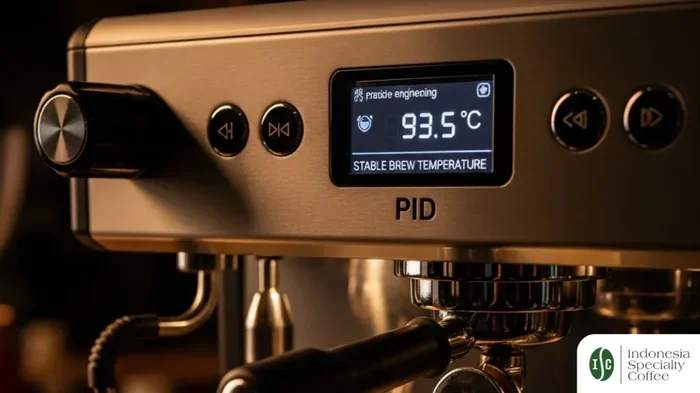
A digital temperature controller with PID capability uses a sensor to read the current heat inside the machine. It compares that reading to the temperature you have set. Then it calculates the difference and adjusts the heating element accordingly.
This happens continuously. Unlike a basic thermostat that just turns the heat on and off, a PID system makes hundreds of micro-adjustments. The result is much tighter temperature control. For espresso brewing, this precision is everything.
If you have ever noticed that one shot of espresso tastes different from the next, inconsistent temperature is often the culprit. A PID controller coffee machine solves this problem by keeping the heat rock solid.
Why PID Temperature Control Matters for Espresso
The Science Behind Brewing Temperature
Espresso is all about precision. The ideal brewing temperature for most espresso falls between 195 and 205 degrees Fahrenheit. Even a few degrees off can change the flavor dramatically. Too hot, and your coffee tastes bitter and burnt. Too cool, and it tastes sour and weak.
A standard thermostat might let the temperature swing by 10 or 15 degrees. That is a huge range when you are trying to extract the perfect shot. A PID algorithm keeps the variation to just a degree or two, sometimes less.
This matters because coffee extraction is a chemical process. Heat drives the extraction of oils, acids, and sugars from the grounds. When the temperature is stable, you get a balanced, flavorful cup every single time.
How Temperature Affects Coffee Extraction
Temperature has a direct impact on how flavors are pulled from the coffee grounds. Here is a quick look at what happens at different temperatures:
- Too low (below 190°F): Under-extraction occurs. The coffee tastes sour, thin, and lacks sweetness.
- Just right (195-205°F): Balanced extraction. You get a smooth, flavorful shot with good body.
- Too high (above 205°F): Over-extraction happens. The coffee turns bitter, harsh, and astringent.
When your machine has a digital temperature controller with PID, you remove the guesswork. The machine holds the sweet spot so you can focus on everything else, like grind size and dose.
Just as precise temperature matters in the kitchen, it matters even more in espresso. If you have ever wondered about how other appliances handle temperature, you might find it interesting to explore how slow cooking relies on steady oven heat for the same reason PID matters in coffee.
PID vs Traditional Thermostat: Key Differences
How Traditional Thermostats Work
Most basic coffee machines use a simple thermostat. This is a switch that turns the heating element on when the temperature drops below a set point and turns it off when it reaches that point. It is a binary system. It is either on or off.
The problem is that this creates temperature swings. The heat overshoots, then undershoots, then overshoots again. For something like a slow cooker, these swings might not matter much. But for espresso, they can ruin your shot.
Think about how an air fryer relies on rapid and consistent heat to cook food evenly. The same principle applies to espresso. Inconsistent heat means inconsistent results.
Why PID Controllers Are More Precise
A PID controller eliminates those swings by making continuous, tiny adjustments. Instead of a simple on-off cycle, it modulates the power going to the heating element. This keeps the temperature much more stable.
Here is a quick comparison:
- Traditional Thermostat: Temperature swings of 10-15 degrees. On-off cycling. Less consistent results.
- PID Controller: Temperature swings of 1-2 degrees. Continuous micro-adjustments. Highly consistent results.
The difference is night and day. If you are serious about your espresso, a PID-enabled espresso machine is a must-have.
Benefits of a PID-Enabled Coffee Machine
Consistency Across Brews
The biggest advantage of PID technology is consistency. Every shot of espresso you pull will be brewed at nearly the same temperature. This means the flavor stays the same from the first cup to the tenth cup.
For home baristas who pull multiple shots in a session, this is huge. You do not have to worry about the second shot tasting different from the first because the machine got too hot.
Better-Tasting Espresso at Home
When your espresso machine temperature is stable, the extraction improves. You get a fuller body, better crema, and a more balanced flavor profile. The difference is noticeable even in a blind taste test.
Many coffee professionals agree that temperature accuracy is one of the most overlooked factors in making great espresso at home. A PID controller fixes this problem completely.
Energy Efficiency and Longevity
Because a PID system makes smaller, smarter adjustments, it does not waste energy the way a basic thermostat does. The heating element runs less frequently and for shorter bursts. Over time, this can extend the life of your machine.
Less wear and tear on the heating element means fewer repairs and a longer-lasting home espresso setup. That is a win for both your coffee and your wallet.
Temperature control is not just about coffee machines. Even baking focaccia requires precise oven temperature to get the right crust and crumb, showing how PID-like consistency benefits all kinds of cooking.
How to Use and Adjust PID Settings on Your Machine
Finding the Right Brewing Temperature
Most PID-enabled espresso machines come with a default temperature setting. This default is usually a good starting point, around 200 degrees Fahrenheit. But the best temperature for you depends on your coffee beans, roast level, and personal taste.
Here are some tips for finding your ideal brewing temperature:
- Light roasts: Try slightly higher temperatures, around 203-205°F, to bring out the sweetness.
- Medium roasts: Stick around 200°F for a balanced flavor.
- Dark roasts: Go slightly lower, around 195-198°F, to avoid bitterness.
Start with the default setting and make small adjustments. Taste the difference. Adjust again. This process of PID calibration is part of the fun of making espresso at home.
Fine-Tuning Your PID Controller
Some advanced machines let you adjust the PID parameters themselves. This means you can tweak the Proportional, Integral, and Derivative values to match your specific machine and environment.
For most users, the default PID settings work perfectly. But if you live in a very hot or cold climate, or if your machine is in a spot with lots of temperature changes, fine-tuning can help.
Quick tip: If you are not sure where to start, leave the PID settings at default. Focus on your grind size, dose, and tamp first. Those factors have a bigger impact on your espresso than PID tweaks for most people.
Common Mistakes with PID Coffee Machines
Not Letting the Machine Warm Up
Even with PID, your machine needs time to reach the target temperature. A PID controller will maintain the heat, but it cannot heat a cold machine instantly. Always give your machine at least 15 to 20 minutes to warm up before pulling your first shot.
This is especially important if you have just turned the machine on or if it has been sitting idle for a while. A warm machine is a stable machine.
Ignoring Group Head Temperature
Some coffee machine electronics control the boiler temperature with PID but do not account for the group head. The group head can lose heat when you insert the portafilter, which can temporarily drop the espresso brewing temperature.
To combat this, many baristas run a blank shot (without coffee) before pulling an actual espresso. This warms the group head and stabilizes the temperature. It is a small step that makes a big difference.
Over-Tuning the PID Settings
If your machine allows PID adjustments, it can be tempting to tweak every setting. But over-tuning can actually make things worse. Small changes to the PID parameters can cause the system to oscillate or behave unpredictably.
Stick to small, one-at-a-time changes. Give each adjustment a few test shots before changing anything else. Patience is key when working with PID technology.
Is a PID Coffee Machine Right for You?
The answer depends on how much you care about your coffee. If you are happy with a basic machine that gives you a decent cup every morning, a PID controller might not be essential. But if you are serious about espresso and want the best possible flavor, PID temperature control is a feature you will appreciate every single day.
PID vs manual temperature control is not even close. Manual thermostats are fine for basic tasks, but they simply cannot match the precision of a PID system. For home espresso, that precision translates directly into better taste.
If you are shopping for a new machine, look for one that explicitly mentions PID in its specifications. Many mid-range and high-end espresso machines now come with PID as a standard feature. It is one of the best investments you can make for your home espresso setup.
Just as different appliances serve different purposes in the kitchen, temperature control matters across the board. For example, understanding how pot roast benefits from steady oven temperatures is similar to how espresso benefits from stable brewing heat. Precision is key in both cases.
Final Thoughts on PID in Coffee Machines
PID stands for Proportional Integral Derivative, and it is one of the most impactful features you can have in a coffee machine. It keeps your brewing temperature stable, your espresso consistent, and your flavor balanced. Whether you are a casual coffee drinker or a dedicated home barista, a PID controller coffee machine can genuinely elevate your daily routine.
The technology is not magic, but it comes close. By making hundreds of tiny temperature adjustments every second, a PID system creates the stable environment your coffee needs to shine. If you have not experienced a PID-enabled espresso machine yet, it is well worth trying one.
Start with the basics. Learn your preferred brewing temperature. Experiment with different beans and roasts. And enjoy the process of making better coffee at home. That is what this journey is all about.
Frequently Asked Questions
What does PID stand for in a coffee machine?
PID stands for Proportional Integral Derivative. It is a smart temperature control system that continuously adjusts the heat in your coffee machine to keep it at a stable, precise temperature. This results in more consistent and better-tasting espresso.
Do I really need a PID coffee machine at home?
If you care about the quality of your espresso and want consistent results shot after shot, a PID coffee machine is a great investment. It removes temperature swings that can cause inconsistent flavor. For casual coffee drinkers, a basic machine may be enough, but for enthusiasts, PID makes a noticeable difference.
Can I adjust the PID settings on my coffee machine?
Many PID-enabled machines allow you to adjust the target temperature, and some even let you tweak the PID parameters themselves. However, the default settings work well for most people. If you do adjust the settings, make small changes and test a few shots before making further adjustments.
What is the best brewing temperature for espresso with a PID machine?
The ideal brewing temperature for most espresso is between 195 and 205 degrees Fahrenheit. Light roasts often do better at the higher end, while dark roasts shine at slightly lower temperatures. A PID controller coffee machine lets you set and hold your preferred temperature with precision.
How does PID technology improve coffee extraction?
PID technology keeps the espresso machine temperature stable, which leads to more predictable and balanced extraction. When the temperature is consistent, the coffee grounds release their oils, acids, and sugars in a controlled way, resulting in a smoother and more flavorful cup.
Are PID coffee machines more expensive than regular machines?
PID-enabled machines can cost a bit more than basic models, but the price difference has gotten smaller over the years. Many mid-range machines now include PID as a standard feature. Considering the improvement in temperature accuracy and consistency, the extra cost is usually well worth it for coffee lovers.